Peaslee regains original consciousness
The Colour Out of SpaceNathaniel Wingate Peaslee’s return to his original consciousness on September 27, 1913, ended more than five years of amnesia and revealed that the apparent resumption of an ordinary life concealed a second, radically different history. The change came through a sequence of unexplained absences and bodily signs: a strange machine vanished from his house, an unknown visitor disappeared, and Peaslee emerged from unconsciousness speaking again as the professor whose last remembered moment was an economics lecture in 1908.
The Night Before the Return
In the summer of 1913, Peaslee had begun hinting to associates that he expected a change. He spoke of memories returning, though listeners doubted him because his recollections were casual and could have come from his private papers. After returning to Arkham in mid-August, he reopened his long-closed house on Crane Street and installed a curious apparatus assembled from parts made by scientific-instrument makers in Europe and America. Its construction was concealed from anyone likely to analyse it. Those who glimpsed it described rods, wheels, and mirrors in a compact frame about two feet high, one foot wide, and one foot deep, with a circular convex mirror at its centre.
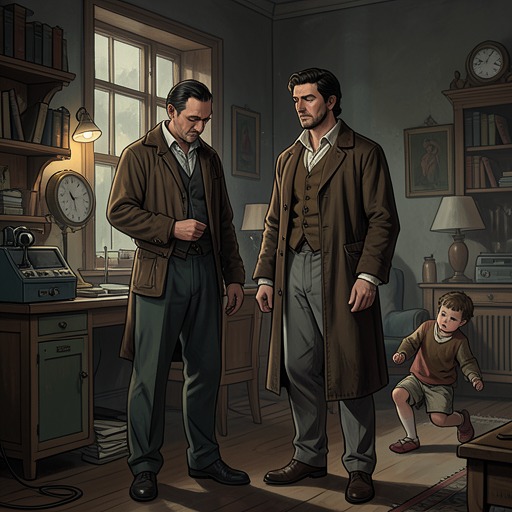
On Friday evening, September 26, Peaslee dismissed the housekeeper and maid until noon the next day. Lights remained on late, and a lean, dark, foreign-looking man arrived by automobile. The lights were last seen around one in the morning. A policeman observed the darkened house at 2:15, while the stranger’s motor was still at the curb; by four, the vehicle was gone. At six, Dr Wilson received a hesitant call in a foreign voice asking him to come to the house and revive Peaslee from a peculiar faint. The long-distance call was traced to a public telephone booth in Boston’s North Station, but the visitor himself was never found.
The Apparatus and the Unconscious Body
Dr Wilson discovered Peaslee unconscious in the sitting room, seated in an easy-chair before a table. Scratches on the polished tabletop marked where a heavy object had rested. The unusual machine was missing, and no one heard of it again. The account identifies the foreign visitor as its likely remover, but gives no independent confirmation of what he did or where he went. The apparatus’s disappearance, the motor’s departure, and the call from Boston leave the return surrounded by evidence of a carefully concealed operation rather than a witnessed explanation.
The house also held evidence of deliberate erasure. In the library grate, Dr Wilson found abundant ashes, apparently from the burning of every remaining scrap of paper Peaslee had written since the onset of his amnesia. Peaslee’s breathing was so peculiar that the doctor gave him an hypodermic injection; afterward, it became more regular. His body was present, but its condition offered no simple account of who had occupied it or how the change had begun. The destroyed papers further meant that the record of the amnesiac years had been reduced just as Peaslee himself was about to recover.
Recognition Through Speech
At 11:15 on the morning of September 27, Peaslee stirred vigorously. His previously mask-like face began to show expression. Dr Wilson judged that the expression did not belong to Peaslee’s secondary personality and instead resembled his normal self. This recognition was not initially a statement from Peaslee; it was an observation of his changing face, an outward sign that the doctor could distinguish between the personality he had known during the intervening years and the one now returning.
At about 11:30, Peaslee muttered syllables that seemed unrelated to any human speech and appeared to struggle against something. Just after noon, with the housekeeper and maid back in the house, he began speaking English. The first words were not an account of the vanished machine or the stranger. They were a fragment of a lecture: “... of the orthodox economists of that period, Jevons typifies the prevailing trend toward scientific correlation. His attempt to link the commercial cycle of prosperity and depression with the physical cycle of the solar spots forms perhaps the apex of ...” The unfinished sentence restored the scene he remembered: Thursday morning in 1908, with his economics class looking toward the battered desk on the platform.
The Five-Year Rupture
Peaslee had returned in a body that had lived through more than five years he could not remember, while his recovered sense of time remained fixed at the instant his former life had broken off. The economics lecture made that discontinuity unmistakable. His first English words belonged not to September 1913 but to a classroom in 1908, so the return was both a recovery of identity and a collision between two incompatible presents.
The recovery did not erase the consequences of the interval. Peaslee’s return to ordinary life was painful and difficult; the lost years had left countless matters to settle, and what he learned about his actions during the amnesia astonished and disturbed him. He tried to face those facts philosophically, later regained custody of his second son, Wingate, and attempted to resume teaching after the college offered him his former professorship. The scene therefore marks a decisive restoration, not a simple reversal: Peaslee’s normal consciousness came back, but it came back to a life altered by everything that had happened in its absence.